
Best Practices During Times of Uncertainty
InvestmentMarket Volatility
As conditions in the Middle East continue to evolve, many investors are asking whether action is necessary. Over the past year, markets have been influenced by interest rates, inflation, trade policy, political developments, and global events. Periodic market reactions to headlines are expected and part of the investment landscape.
Regardless of the decade, the fundamental challenge for investors remains unchanged: separating short‑term noise from meaningful long‑term trends while maintaining discipline. There will always be reasons for concern, but markets have historically adapted to an ongoing stream of uncertainties.
Key drivers of recent volatility
- Inflation and Interest Rates: Market movements are often driven by changes in expectations rather than by economic data alone. The recent shift from anticipated rate hikes to potential cuts reflects this dynamic.
- Geopolitics and Trade Policy: Geopolitical events can lead to abrupt market volatility. Historically, these shocks are often temporary unless they cause lasting disruption to global supply chains.
- Election Cycles: Elections introduce uncertainty, but markets typically begin pricing in these contingency risks months before votes are cast.
Historical perspective
Economic cycles of expansion and recession are normal. While past performance does not predict future outcomes, understanding historical patterns can provide valuable perspective during periods of uncertainty. Historically, bull markets have lasted longer and generated significantly higher cumulative returns than bear markets.
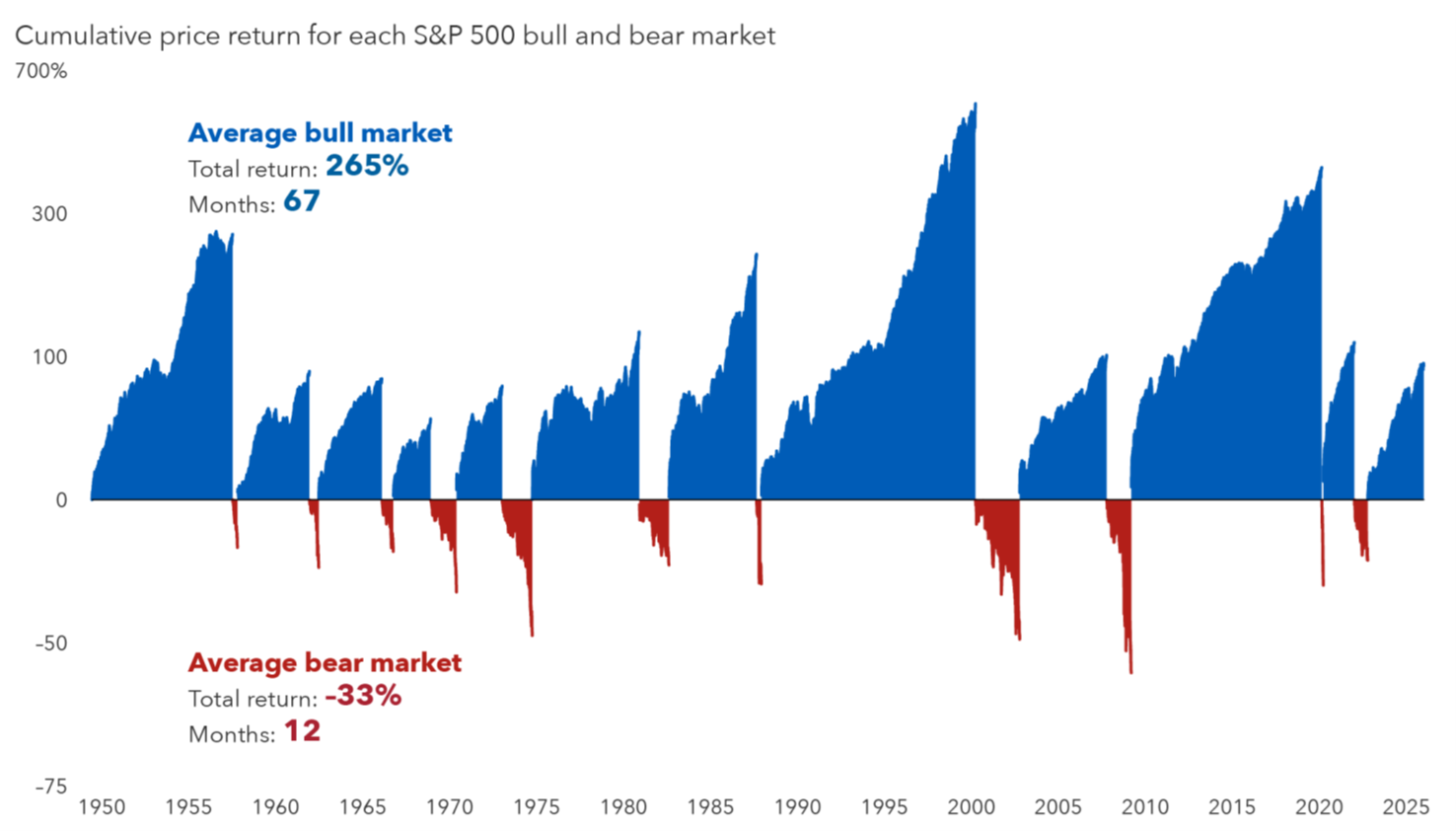
Sources: Capital Group, RIMES, Standard & Poor's. As of December 31, 2025. The bull market that began in 2022 is considered current as of 12/31/2025 and is not included in the "average bull market" calculations. Bear markets are peak-to-trough price declines of 20% or more in the S&P 500. Bull markets are all other periods. Returns shown on a logarithmic scale.
Key Takeaway
- Longer investment horizons improve the likelihood of capturing full market cycles and their associated returns
- Bear markets, defined by downturns of at least 20%, have historically been shorter and less frequent, averaging 12 months, while bull markets average 67 months with an average return of 265%.
- Media coverage often amplifies conflicting narratives. Our role as your financial professional is to monitor conditions, evaluate risks and help you focus on long term objectives rather than short term headlines.
The cost of market timing
Emotional decision‑making during periods of volatility can undermine investment success. Missing just a small number of the market’s strongest days can significantly reduce long‑term returns. For example, missing the 10 best days over a decade can reduce returns by nearly half compared with staying fully invested.
Timing the market can be costly.
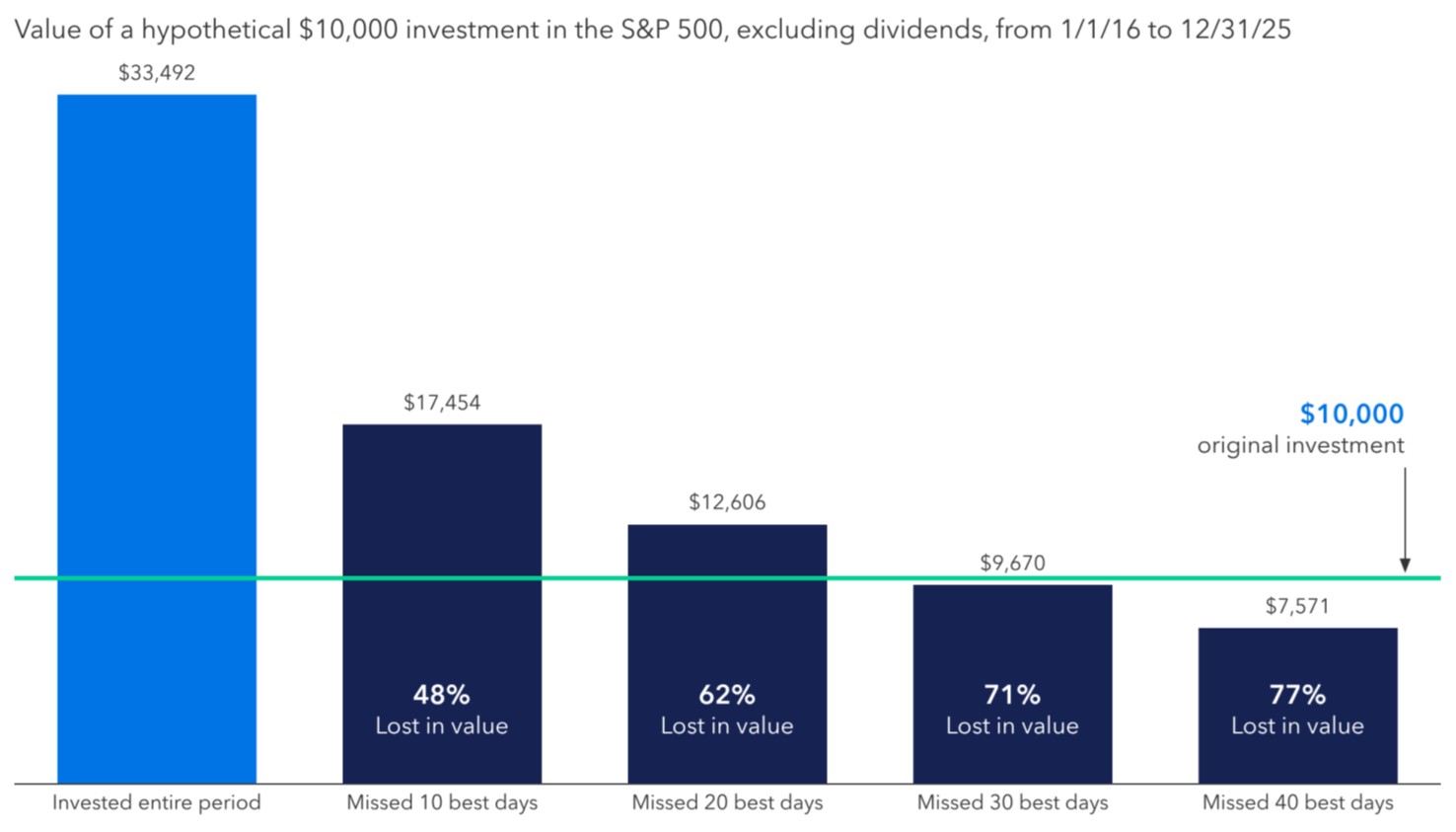
Sources: Capital Group, RIMES, Standard & Poor's. As of December 31, 2025.
Despite periodic intrayear declines, the market has delivered positive annual returns in most years.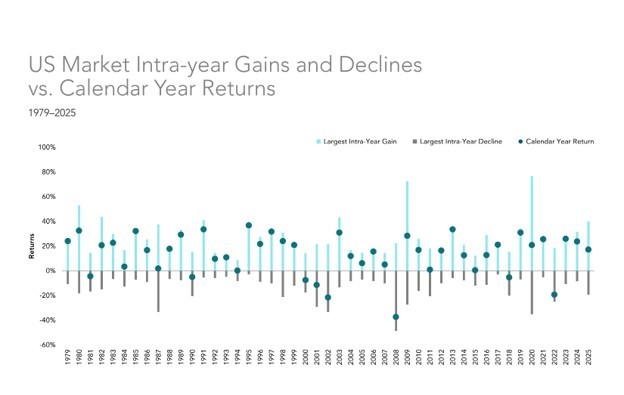
Source: Dimensional, Past performance is not a guarantee of future results. Indices are not available for direct investment; therefore, their performance does not reflect the expenses associated with the management of an actual portfolio. In USD. Data is calculated off rounded daily returns. US Market is the Russell 3000 Index. Largest Intra-Year Gains refers to the largest market increase from trough to peak during the year. Largest Intra-Year Decline refers to the largest market decrease from peak to trough during the year. Frank Russell Company is the source and owner of the trademarks, servicemarks, and copyrights related to the Russell Indexes.
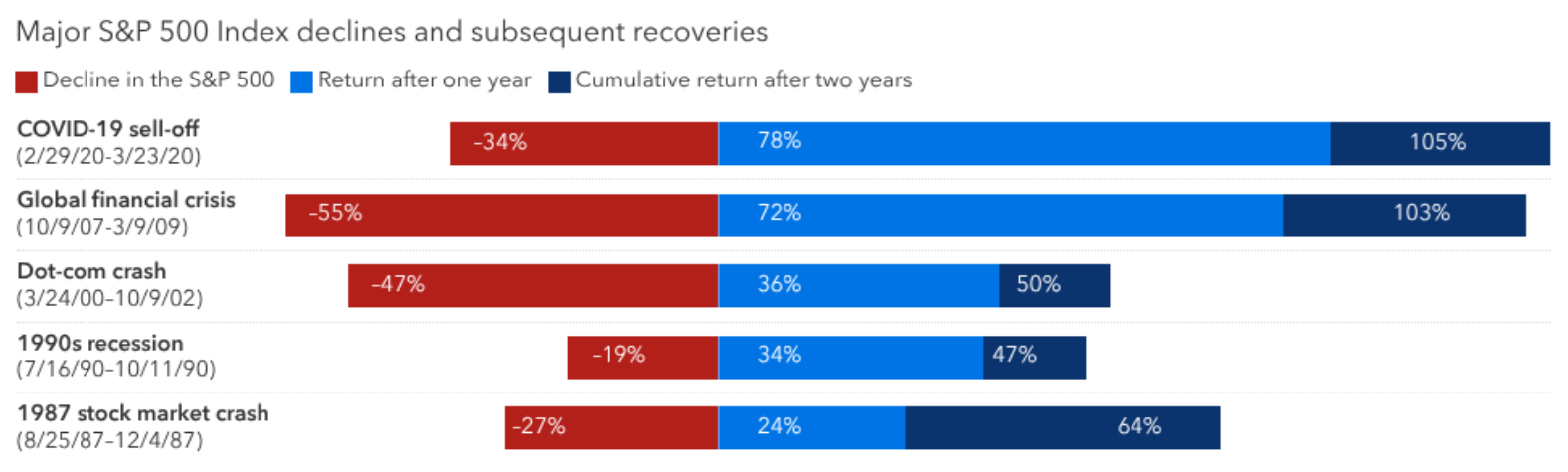
Market downturns can be unsettling, but recoveries have often been swift. Historically, a substantial portion of long‑term gains have occurred in the early stages following major declines.
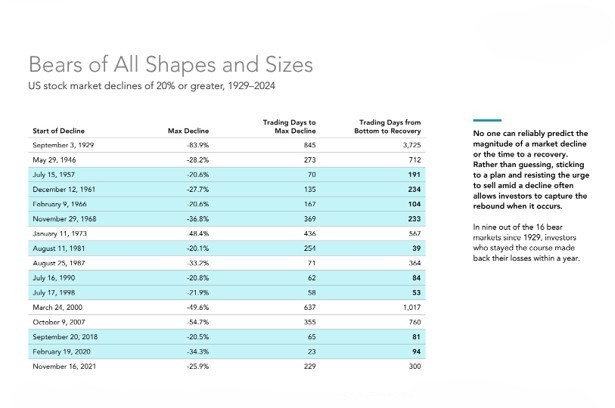
Source: Dimensional, Past performance is no guarentee of future results. Actual returns may be lower. In USD. The Fama/French Indices represent academic concepts that may be used in portfolio construction and are not avaialable for direct investment or for use as a benchmark. Index returns are not representative of actual portfolios and do not reflect costs and fees associated with an actual investment. See "Index Descriptions" in the appendix for descriptions of the Fama/French index data. Includes any decline of 20% or more beginning the day after a new all-time high for the market. Recovery is defined as the first day when the cumulative return since the previous market high is no longer negative. US stock market represented by the Fama/French Total US Market Research Index. Eugene Fama and Ken French are members of the Board of Directors of the general partner of, and provide consulting services to, DImensional Fund Advisors LP.
Following the five largest declines since 1987, the S&P 500 gained nearly 49% on average in the first year of recovery at the height of pandemic-induced market volatility in 2020, the S&P 500 declined 34%. However, over the next year, markets bounced back and reached new highs for a return of 78%. A similar story unfolded during the global financial crisis and other periods of intense market volatility: the largest returns were concentrated in the first year after the downturn.
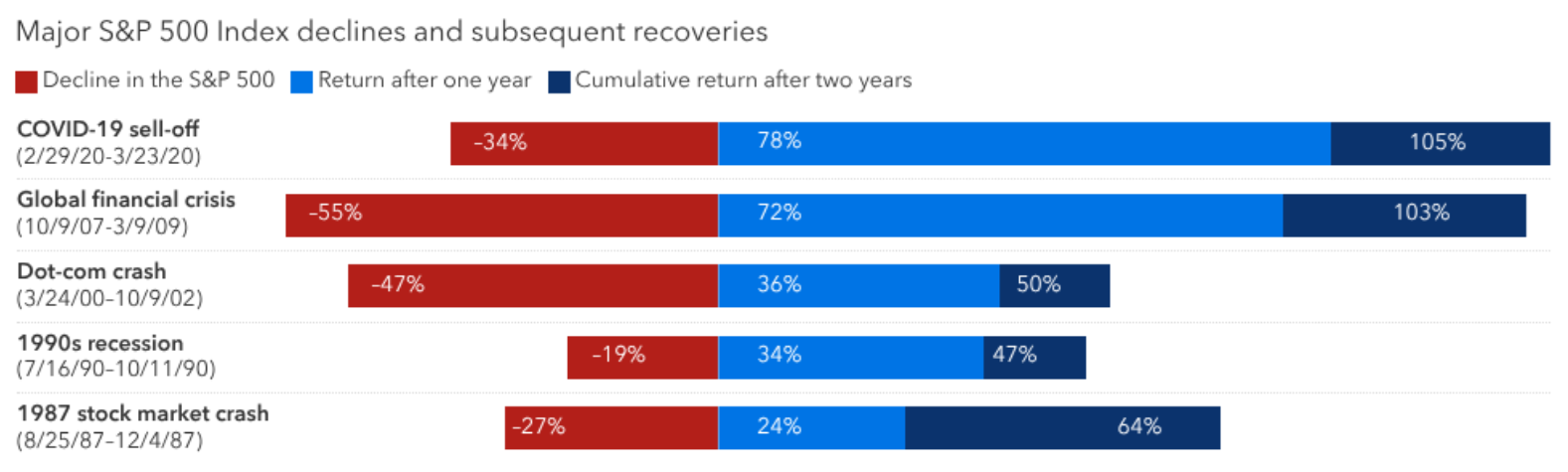
Sources: Capital Group, Standard & Poor's. Return figures represent cumulative total returns for the S&P 500 Index. Market downturns shown are based on the five largest declines in the S&P 500's value since 1987 (excluding dividends and/or distributions) with 100% recovery after each decline. The percentage decline is based on the index value of the unmanaged S&P 500, excluding dividends and/or distributions. As of December 31, 2025.
Staying disciplined
Volatility does not mean ignoring your investments. A disciplined, flexible strategy helps you capitalize on opportunities aligned with your goals, risk tolerance, and time horizon.
The planning already in place allows you to stay focused on what matters most, while we continue to monitor conditions on your behalf. If you’ve experienced recent life changes or wish to revisit your long‑term plan, we are here to support you. Please reach out with any questions regarding current events or market conditions.