

Can You Successfully Time the Market?
InvestmentEven short periods out of the market can significantly reduce long-term returns. Market timing is notoriously difficult because success requires being right twice. Investors must correctly predict when to sell at a peak and then when to buy back in at a bottom. More often, investors miss gains, incur higher taxes, and add unnecessary costs.
Many investors believe they should have sold before major events, whether geopolitical conflicts or trade tensions. But even with perfect foresight, would you have had the confidence to reinvest amid declining markets and alarming headlines? Hypothetically, let’s say you did have the foresight to sell in February 2026 before the Middle East conflict became front-page news. Would you have had the confidence to buy in late March when the Dow Industrials closed lower for the fifth consecutive week, and oil prices topped $110 per barrel? Maybe… but as I write this, the market is up 2% since this morning’s open, and oil has dropped 14% to $81 per barrel.
Did you buy in time to capture this upswing? Markets are efficient and by the time headlines turn positive, markets have often already priced in the recovery. Why the sudden reversal, even as global headlines remain relatively bleak? Markets react not just to news, but to how outcomes compare with expectations. Historically, the best market days occur in short, unpredictable bursts, and missing even a few can materially hurt performance.
As Warren Buffett famously noted, “the rearview mirror is always clearer than the windshield.”
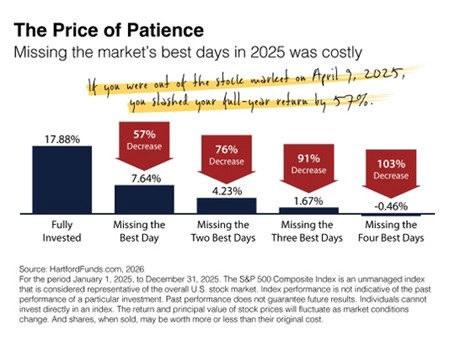
Volatility is likely to persist due to geopolitical uncertainty, midterm elections, and unclear Fed monetary policy. Decades of research from Morningstar, Dimensional, and others consistently show that market timing rarely improves results. Rather than trying to predict short-term movements, a focus on diversification, valuation, rebalancing, and patience has historically led to better outcomes.
For the period January 1, 2025, to December 31, 2025. The S&P 500 Composite Index is an unmanaged index that is considered representative of the overall U.S. stock market. The Dow Jones Industrial Average is an unmanaged index generally considered representative of large-capitalization companies on the U.S. stock market. Index performance is not indicative of the past performance of a particular investment. Past performance does not guarantee future results. Individuals cannot invest directly in an index. The return and principal value of stock prices will fluctuate as market conditions change. And shares, when sold, may be worth more or less than their original cost.