
Market Forecasters’ Report Card
InvestmentIt’s that time of year again when the financial world is flooded with "expert" predictions of where the S&P 500 will end the year. These forecasts may appear informative, but history shows they are inconsistent, frequently revised, and rarely a reliable guide for investor decision‑making.
Why Forecasts Often Miss the Mark
Forecasts reflect an analyst’s interpretation of data available at a given moment, and interpretations often vary widely. More importantly, no forecast can anticipate unexpected policy shifts, geopolitical events, or economic surprises.
Consider last year as an example:
- Initial outlook: Analysts projected roughly a 10% gain for 2025.
- Mid‑year reversal: In April 2025, shifting tariff policies prompted many firms to sharply cut their estimates, with more than half predicting negative returns.
- Actual Outcome: Despite the pessimism, the S&P 500 closed 2025 with a strong 17.9% gain well above both the original and revised estimates.
These forecast swings highlight the limits of placing significant weight on short‑term predictions.
The Cost of Following the Noise
The real risk isn’t inaccurate predictions it’s how investors react to them.
When sentiment turned negative in April, many investors who followed the revised forecasts sold near the bottom. Those who exited missed the subsequent 11.5% rebound in May and June. Staying invested wasn’t necessarily comfortable, but it meant participating fully in the recovery and the strong results that followed.
Investors who remained disciplined were rewarded. Those who reacted to short‑term noise were not.
Comparing Consensus vs. Actual Returns
Recent history shows a persistent gap between estimates and actual market performance.
Consensus S&P 500 Estimates vs. Actual Returns (2018-11/30/2025)
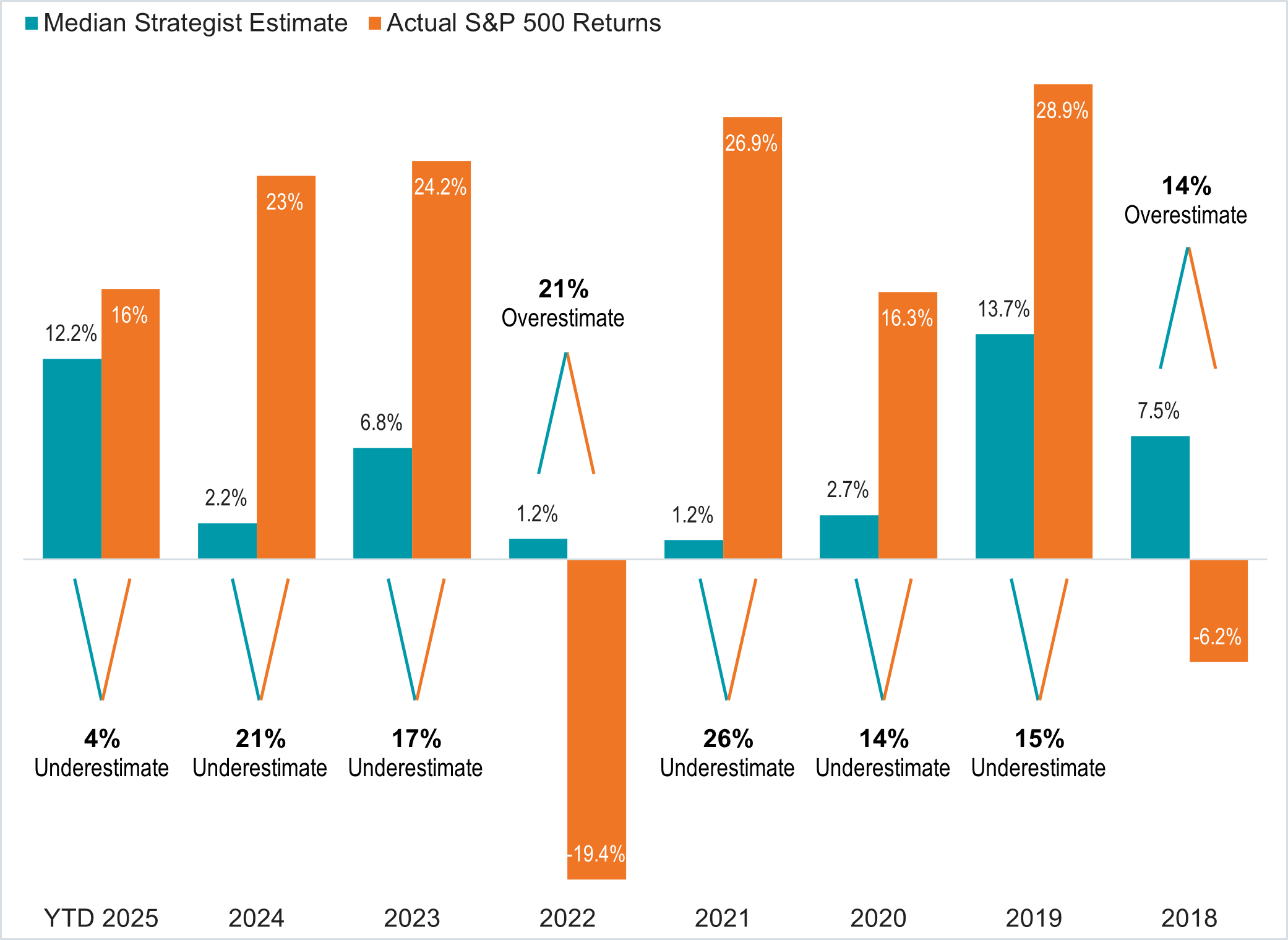
Data from 1/1/2018 - 11/30/2025. Sources: Emily McCormick, “What Wall Street Strategists Forecast for the S&P 500 in 2019,” Yahoo Finance, December 31, 2018; Jeff Sommer, “Clueless About 2020, Wall Street Forecasters Are at It Again for 2021,” New York Times, December 18, 2020; Jeff Sommer, “Forget Stock Predictions for Next Year. Focus on the Next Decade,” New York Times, December 16, 2022; Senad Karaahmetovic, “Top Wall Street Strategists Give Their S&P 500 Forecasts for 2023,” Investing.com, December 27, 2022; Tom Aspray, “Should You Worry That Strategists Keep Raising Their S&P 500 Targets?” Forbes, October 20, 2024. Past performance is no guarantee of future results.
The takeaway is clear, if professional forecasters can’t consistently predict one‑year outcomes, investors should be cautious about using those predictions to guide portfolio decisions.
Focus on the Long-Term
Long‑term success comes not from anticipating the next 12 months but from maintaining discipline through market fluctuations. The S&P 500 has delivered roughly 10% average annual returns over many decades, regardless of short-term forecasts. Trying to outmaneuver short‑term movements often leads to worse outcomes than simply staying invested.
Good News for Investors
You don’t need to predict the market to benefit from it. What matters most is staying invested, especially during periods of uncertainty. Markets reward discipline and patience, and investors who remain committed through downturns are better positioned to capture the recoveries and long‑term growth that follow.
No forecasts required, just a durable plan and the discipline to follow it.