
Market Volatility During Middle East Conflict
Investment GeneralAs events in the Middle East evolve, many investors are asking: “Should we do anything?”
Over the past year, interest rates, inflation, tariffs, political developments, and international tensions have all influenced market movements, so renewed volatility is to be expected.
Geopolitical tensions increased last week as military action heated up in the Middle East. While the conflict remains geographically contained, concerns persist regarding its potential impact on oil supply, energy prices, and broader supply chains. Although uncertainty is elevated, history shows that markets have weathered similar periods of conflict. Nearly a century of U.S. market data provides meaningful perspective on how equities have responded following the onset of major military engagements.
U.S. Stocks Have Shown More Volatility in the Short-Term but Resilience Over the Longer Term Following Major Conflicts
U.S. Stock Performance After Conflicts
EVENT | DATE | 3 MO (%) | 1 YR (%) | 3 YR (%) |
|---|---|---|---|---|
WWII/Pearl Harbor Attack | 12/8/1941 | -8.14 | 16.49 | 21.96 |
Korean War | 6/25/1950 | 11.74 | 27.78 | 16.37 |
Bay of Pigs Invasion | 4/17/1961 | 2.62 | 1.76 | 8.76 |
Cuban Missile Crisis | 10/16/1962 | 18.30 | 34.01 | 21.13 |
Vietnam War | 8/2/1964 | 4.18 | 10.83 | 10.24 |
Yom Kippur War/ Oil Embargo | 10/6/1973 | -10.72 | -31.30 | 1.79 |
Iran-Iraq War | 9/22/1980 | 9.21 | -2.01 | 16.65 |
Lebanon War | 6/6/1982 | 11.58 | 67.02 | 26.15 |
US Invasion of Panama | 12/20/1989 | -3.33 | -6.02 | 11.62 |
Gulf War | 8/2/1990 | -0.22 | 28.85 | 18.36 |
Operation Infinite Reach | 8/7/1998 | 21.74 | 39.30 | 7.56 |
9/11 Attack on WTC/Afghanistan War | 9/11/2001 | 12.55 | -17.87 | 5.93 |
Iraq War | 3/20/2003 | 16.68 | 39.18 | 19.34 |
Russia Invades Ukraine | 2/24/2022 | -6.91 | -8.67 | 11.79 |
Hamas Attacks Israel | 10/7/2023 | 16.47 | 38.49 | - |
Twelve Day War Between Israel & Iran | 6/22/2025 | 8.48 | - | - |
Operation Epic Fury | 2/28/2026 | - | - | - |
Avantis Investors - Data from July 1926 – December 2025. Source: Ken French Data Library. Past performance is no guarantee of future results.
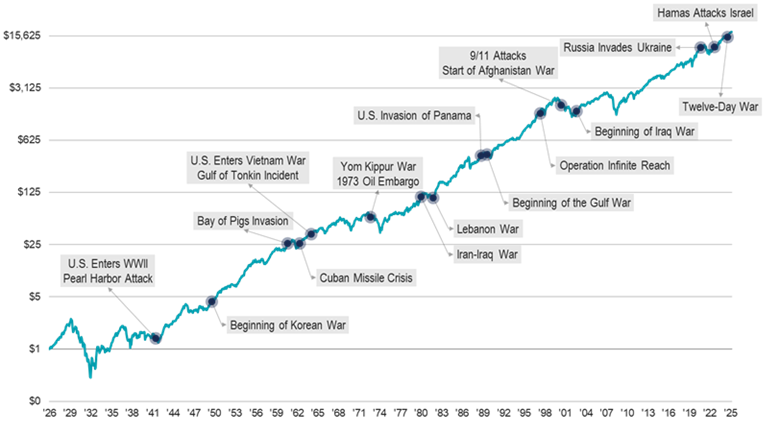
When you compare the conflicts above with the long‑term growth of one U.S. dollar since 1926, the market’s enduring resilience despite periods of war and geopolitical disruption stands out.
With Military Conflicts, Long-Term Discipline Is Key for Investors Growth of $1 in U.S. Stocks Since 1926
Avantis Investors - Data from July 1926 – December 2025. Source: Ken French Data Library. Past performance is no guarantee of future results.
Regardless of the time horizon, we observe more positive than negative market returns. Following major geopolitical events, it is likely that markets may be more volatile in the short term as uncertainty rises and new information is quickly reflected in prices, but that doesn’t guarantee markets will decline even three months out. But importantly, as the time horizon extends beyond major conflicts, the likelihood of positive market returns increases. Notably, there were no negative returns in any of the three-year periods following the conflicts examined, and the average of the 3-year annualized returns in the sample was about 13%. As time goes on, event-driven uncertainty often subsides, and investors who remain disciplined are typically rewarded for staying the course.
We recognize that investors are human and have emotions, and events like military actions can evoke strong feelings. That’s natural. However, for investors, allowing emotion or anxiety about the events of the world to drive meaningful investment changes is not something that’s supported by historical data. Instead, it offers strong evidence that sticking to your financial plan is likely the prudent course of action during these times. Staying grounded in long‑term goals, time horizon, and risk tolerance is essential.
Remember, reacting to short-term volatility has historically proven more damaging than the events themselves. But if the news has caused concern about your risk tolerance, please reach out. If you’ve experienced recent life changes or wish to revisit your long‑term plan, we are here to support you. Please reach out with any questions regarding current events or market conditions.